| |||||||||

Wednesday, May 3, 2017
Carl Solway Gallery at Frieze New York


Friday, April 7, 2017
Catherine Richards Performance at Carl Solway Gallery, April 8, 2017
|
Monday, March 27, 2017
Julian Stanczak (1928-2017)
Julian Stanczak, globally renowned Op artist based in
Cleveland, has died at age 88
SEVEN HILLS, Ohio - Julian Stanczak, a native of
Poland who survived World War II as a child to become a globally renowned
exponent of Op Art and a
revered professor at the Cleveland
Institute of Art, died Saturday morning at his home here at age 88.
Barbara Stanczak, the artist's wife and a respected
abstract sculptor and former Cleveland Institute of Art professor, shared the
news of her husband's death in an email to more than 80 friends and
associates across the art world just after 9 p.m. Saturday.
"I want to let you know that Julian is in paradise
now," she wrote. "He has found peace after an exciting life filled
with tragedies as well as many blessings, success, hard work and glorious
visions which he communicated through his art."
Reached at home late Saturday, Barbara Stanczak said her
husband died under hospice care after having been treated for pneumonia and
other illnesses.
"Everybody knows he was a unique human being, not
only a talented artist, but as a person, unsurpassed," she said.
Despite suffering great pain in recent years from
injuries suffered as a child in a Soviet labor camp, Stanczak continued to turn
out astonishingly precise and meltingly beautiful geometric abstractions
that radiated serenity, calm and a sense of wonder about light, color and the
visual energy of linear patterns.
And, after decades in which his work and that of other Op
Artists was viewed with enormous disfavor, if not ridicule, Stanczak lived long
enough to see a complete turnaround in the art world's view of his art.
Over the past decade and a half, Stanczak's work was the
subject of more than 20 exhibitions in the U.S. and Europe and numerous
publications including a 320-page monograph written by Polish art historian
Marta Smolinska published in Polish and English in 2014.
Prices for Stanczak's work have also skyrocketed in
recent years, reaching as high as $300,000.
In 2012, Bloomberg-Artnet listed
Stanczak as No. 6 on its list of the 15 "hottest artists" in the
world, based on percentage increases in prices from the starting year of
2000.
During the past decade, Julian Stanczak's art has been
enthusiastically rediscovered by museums, galleries and collectors.
"I am numb,"
Stanczak said in a 2009 interview at his home and studio in Seven
Hills. "Once you get older, you look at it with a cat's smile. It's very
pleasant, but where have you been all this time when I needed you?"
Cleveland artist Julian Stanczak, who rocketed to fame as
a progenitor of Op Art in the 1960s, is enjoying renewed acclaim.
Stanczak was a diminutive man who lived an epic life. He
escaped from the Soviet labor camp in Perm, Siberia in 1942 at age 14 and
traveled through Teheran, Iran and India; before living out the war years in
British-controlled Uganda, where he nurtured dreams of becoming an artist.
Rise to greatness
Stanczak later studied art in London, England. He
emigrated to the United States in 1950 and earned a bachelor's degree in art at
the Cleveland Institute of Art in 1954. He then proceeded to Yale University,
where his professors included the famous former Bauhaus instructor Josef Albers.
After completing his master-of-fine-arts degree at Yale
in 1956, Stanczak took a teaching position in Cincinnati, where he lived until
he moved to Seven Hills in 1964, with his wife.
They turned a modest, mid-century home into a comfortable
modernist-style refuge filled with artworks and with furniture that Stanczak
built by hand. And they raised their children, Christopher and
Danusia and cared for Stanczak's aging parents, who moved into the
house across the back yard
In a large studio on the rear of the house, Stanczak
produced vibrant geometric abstractions with precise linear and geometric
patterns in scintillating hues and patterns.
Creating with one arm
Amazingly, he did it all with the use of only his left
hand and arm.
He
was a unique human being, not only a talented artist, but as a person,
unsurpassed.
After Soviet troops occupied his hometown of Borownica,
Poland, Stanczak was deported at age 11 with family members to the labor camp
in Siberia.
He was beaten so severely there that he lost the use of
his right arm - a terrible fate for a future artist who was right-handed.
"I still dream I am using my right arm,"
Stanczak said in a 2009 interview at his home and studio. "Then in my
dreams, I correct myself."
Stanczak made up for his handicap in numerous ways
including his construction of rotary cutting device made of gears, spools
and blades that allowed him to slice strips of masking tape he needed for his
abstractions in highly precise widths.
Stanczak's type of art was so precise that deviations
from perfection would have drawn the eye to any flaws.
Yet Stanczak achieved extreme precision both in his
taping and painting techniques and in his ability to mix colors in
highly subtle gradients of hue and light-dark value.
Early spotlight
In 1965, Stanczak participated with artists such as Victor Vasarely, Bridget Riley and Richard Anuszkiewicz in "The Responsive Eye," the
exhibition at the Museum of Modern Art in New
York that made Op Art
an instant sensation.
Stanczak later said Op Art "is nothing but scrutiny
of how we go about seeing -- how much is sight, how much is mental
interpretation."
After a surge of popularity in which Op Art patterns
appeared on everything from album covers to apparel, the movement suddenly fell
into eclipse as a victim of rapidly changing art world movements and styles.
Roller coaster reactions
The leading critic and art historian Barbara Rose wrote
at the time that, "Op Art goes Pop [Art] one better by being considerably
more mindless."
Barbara Stanczak said viewed such harsh attacks to be the
work of "throat-cutters."
Despite being considered quaintly irrelevant by critics
and curators for nearly three decades, Stanczak continued to pursue his vision.
"Having those 30 years of anonymity in Cleveland and
being away from New York made his work stronger," Barbara
Stanczak said in a 2009 interview.
Beloved teacher
Meanwhile, he became a highly respected instructor at the
Cleveland Institute of Art, where he taught from X to Y, and where his
students included future luminaries such as the landscape painter April Gornik,
and Dana Schutz, known for her bold, imaginary visions.
Barbara Stanczak's email announcing her husband's death was
addressed to Gornik, Grafton Nunes, president of the Cleveland Institute of
Art, and numerous collectors, art dealers and artists.
In addition to his wife, Stanczak is survived by his
brother, Mark Stanczak, and his daughter-in-law, Mary Stanczak, both of Seven
Hills; a son, Christopher Stanczak, of Los Angeles; a daughter,
Danusia Casteel, of Norton, Ohio; two grandchildren and a great grandson.
Arrangements are in care of Ferfolia Funeral Home in
Aurora. Donations may be made to the Julian Stanczak Scholarship Fund at the
Cleveland. Institute of
Tuesday, March 7, 2017
Peter Halley Gouaches on View at Karma, New York
|
Matthew Kolodziej Exhibition at the University of Mount Union
Matthew Kolodziej
Intervals: Small Works
March 3 - April 2, 2017
Reception March 16, 4-6 pm
Sally Otto Gallery
University of Mount Union
Giese Center for the Performing Arts
35 W. Simpson Street
Alliance, OH 44601


Matthew Kolodziej, Storage, 2016, acrylic on canvas, 14 x 17 inches

Matthew Kolodziej, Slice, 2016, acrylic on canvas, 14 x 17 inches

Matthew Kolodziej, Lumen (detail), 2016
Matthew Kolodziej Included in Exhibition at Cleveland State University
The Galleries at Cleveland State University
1307 Euclid Avenue
Cleveland, OH 44115\216-687-2103
THE CURIOUS CASE OF COLOR
Exhibition: March 10 - April 15, 2017
An exhibition exploring color as a primary perceptual phenomenon with works by:
Audra Skuodas
Julian Stanczak
Matthew Kolodziej
Lorri Ott
Rachel Beamer
Lynda Britton
Dennis Long
Paul O’Keeffe
Lorri Ott
John Pearson
Qian Li
Douglas Sanderson
Anna Tararova
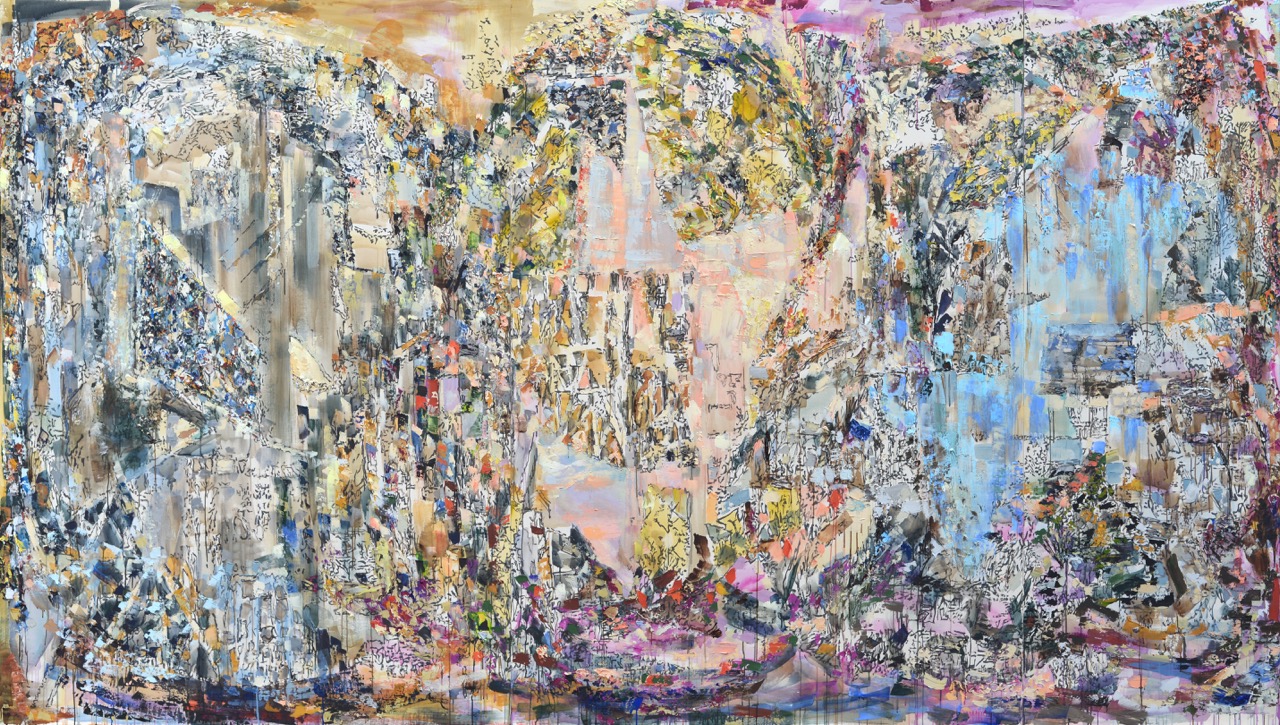
Matthew Kolodziej, Muses, 2016, acrylic on canvas, 108 x 180 inches

Matthew Kolodziej, Muses (detail)

Matthew Kolodziej, Muses (as installed)
Wednesday, February 1, 2017
Matthew Kolodziej's Paintings on View at Moss Arts Center at Virginia Tech
ARTISTS AND ARCHITECTURE:
PROJECTION/CONVERGENCE/INTERSECTION
James Casebere Amy Casey Dionisio González Candida Höfer
Matthew Kolodziej Jean-François Rauzier Jennifer Williams
This exhibition is supported in part by a gift from
Dr. Charles Y. Davis and Mrs. Carole C. Davis.
January 19–April 1, 2017
All galleries
Given the pivotal role and great influence that architecture plays in the human experience, it is not surprising that some artists have found it to be a rich medium to probe—figuratively and thematically—as they explore and attempt to understand the world in which we live. In every society architecture has in some way reflected the ideals, practices, and beliefs of the people who live, work, and worship in the buildings of their towns and cities, and throughout history, the greatness of civilizations has to a significant extent been established by architectural achievements. As life in the 21st century is increasingly centered in urban and metropolitan areas, the role of architecture and the architectural aesthetics of our homes, workplaces, and civic buildings assumes ever more importance. Architecture determines to a great degree what our visual experience is—what we see and what we are surrounded by in our daily lives.
This exhibition features a selection of large-scale works by exemplary emerging artists, as well as some of the most acclaimed national and international artists of our times who inventively engage aspects of architecture in their creative endeavors. Spanning the practices of photography, painting, installation art, and works on paper, the artists in this exhibition project, converge, and/or intersect architectural images and ideas into visually arresting and conceptually layered works of art while addressing underlying issues of history, memory, and place.
Candida Höfer’s resplendent and breathtaking photographs delve into history, bringing into sharp focus architectural splendors of the past. Her magnificent interiors of grand libraries, palaces, opera houses, and theatres reference human achievement of the highest order, yet are devoid of human presence. Infused with this uncanny yet profound paradox, these extraordinarily works signify far more than literal representations of place.
James Casebere too speaks eloquently to history as well as to memory and place in his stunning large-scale photographs of Thomas Jefferson’s most acclaimed architectural achievement—Monticello. Casebere represents Jefferson’s interiors as gorgeous dreamlike spaces flooded with light and shimmering pools of water. But in a conceptual twist on both history and reality, what he portrays in these photographs is not real. These hauntingly beautiful works are created with table-top models that the artist builds, lights, and photographs, essentially reinventing and reconstructing Jefferson’s iconic architectural spaces. “Everything l photograph is a fabrication,” Casebere says. “There’s nothing ‘real’ in my work. I am interested in how photography creates and reconstructs reality.”
Amy Casey’s meticulously detailed acrylic paintings on paper or panel also “reconstruct” the built environment into wild representations of reality. Her fascination with cities and “urbanscapes” is conveyed in these works by surreal clusters of houses whirling in space, precariously suspended at the brink of impending disaster. Less concerned with phenomenology than Casebere, Casey’s depictions of a teetering, chaotic world elicit a very real socio-economic commentary on the uncertain state of affairs in 2009 during the midst of a recession and housing bust. In Hold On, a painting from 2016, elements are more firmly interconnected and bound together, conveying struggle but also resilience and endurance in the face of continuing and pervasive uncertainty.
Jean-François Rauzier’s monumental photographs, or “hyperphotos,” as he terms them, are gigantic, hyper-realistic photographic reconstructions of architectural locations, ranging from the galleries at the Metropolitan Museum of Art in New York to the halls of Versailles, France. Taken from multiple angles and distances, each of his compositions is made up of hundreds and often thousands of digitally composed and reconstructed images with unusually high resolutions. What this achieves is a visual language of extraordinary detail that allows the viewer to zoom in on the most minute details in the midst of vast scale. Compounding the complexity of these works is how the artist juxtaposes, duplicates, and manipulates images to create “hyper-real” architectural fantasies where the real and unreal collide.
Amy Casey
More elusive and steeped in richly tactile, almost viscous surfaces are Matthew Kolodziej’s abstract canvases. His paintings are initially based on his perceptions and documentation of actual archeological and/or architectural sites that he photographs, renders into computer drawings, reconstructs conflating multiple points of view, and then projects onto canvas as a foundation for thick, densely layered paintings. The results are a complexity of tenuous, ever-shifting spatial perspectives that seem to alternate between expansion and contraction, creation and destruction, stability and chaos. In these mesmerizing paintings Kolodziej explores the archaeology and architecture of space, metaphorically probing sites of construction, demolition, transition, and catalytic change.
Realistically depicted and anchored in specific locations are Dionisio González’s stunning panoramic vistas of Vietnam’s Halong Bay in the Gulf of Tonkin. Situated along the spectacular coastline in northern Vietnam, this formerly isolated geographic area is inhabited mainly by impoverished,once secluded people living in houseboats on the water. González captures the extraordinary beauty of this area in expansive digital photographs, into which he interjects imaginary modern and contemporary architectural structures. Likewise, in the Brazilian slums of González’s Favela (2004-2007)series the artist creates the same kind of hypothetical intervention, digitally reconstructing photographic space to comment on the significance of place, social inequities, the collision of global cultures, or, as the artist suggests, a reimagining of possibilities or future utopias.
This projection, convergence, and intersection of architectural images into alternate pictorial realities also characterizes Jennifer William’s site-specific photographic installation, Blacksburg Unfurled (2016-2017). Created specifically for this exhibition and based on the history, architecture, and community of Blacksburg, this 120-foot long mural installation is composed with hundreds of photographs that the artist took of architectural sites and historic locations in town. She then digitally altered, reconstructed, and composed the architectural images into a dynamic photomontage printed on Photo-tex in a wildly imaginative reconfiguration of the built environment that speaks to history, memory, and place.
By incorporating architectural images and ideas in their work, the artists in this exhibition, from James Casebere to Jennifer Williams, engage in collapsing real and fictive imagery, and in so doing, uncover a depth of ideas and perspectives about our world, both past and present. Large in scale and visually seductive, their art takes the intersection of architecture and life as a platform to explore, ponder, and heighten awareness of a variety of ways that architecture and the built environment impact the human experience.
Margo Ann Crutchfield
Curator at Large
Subscribe to:
Posts (Atom)